1. Regional Microclimate Dynamics & Severe Storm Exposure in Newark & North Jersey
Severe meteorological events in North Jersey—including coastal Nor'easters, tropical storm remnants, and violent microbursts—frequently cause catastrophic damage to residential and commercial roofing envelopes. Gale-force winds exceeding 60 mph generate extreme aerodynamic uplift along building ridges, eaves, and urban parapets, tearing brittle asphalt shingles from wood decking and blowing unbonded single-ply membranes from perimeter terminations. When impact punctures or extensive wind blow-offs occur, immediate weatherproofing tarp installation is essential to arrest cascading interior water damage, prevent mold colonization, and protect multi-story residential buildings.
The Newark metropolitan area and greater Essex County experience intense seasonal weather variations shaped by the Atlantic Ocean, Newark Bay, and Passaic River corridors. In winter and early spring, powerful Nor'easters funnel wind-driven rain and sleet against exterior masonry facades, forcing water behind compromised parapet wall copings. In summer, convective thunderstorms dump immense rainfall volumes within minutes, creating dangerous hydrostatic head pressure over low-slope roof membranes and overwhelming perimeter gutter channels.
Key North Jersey Environmental & Structural Stressors:
- Wind Uplift Forces & Coastal Squalls: High-density urban architecture funnels wind currents, increasing wind peel forces along flat roof perimeters, ridge lines, and coping edges.
- Hydrostatic Load Stagnation: Heavy cloudbursts overwhelm internal roof drains and scuppers, accumulating thousands of pounds of deadweight ponding on historic timber decking.
- Masonry Freeze-Thaw Wedging: Water penetrating uncapped parapets and brick chimneys expands upon freezing, fracturing mortar bonds and dislodging critical counter-flashings.
2. Non-Destructive Moisture Diagnostics & FLIR Thermal Tracing
Forensic inspection prior to tarp deployment is critical to ensure worker safety and effective envelope sealing on steep-slope and flat roofs alike. Dispatched technicians evaluate structural roof deck deflection, identify compromised rafter spans beneath puncture points, and map the full perimeter of membrane or shingle detachment using non-destructive moisture meters. Technicians locate solid framing members and structural rafters to establish robust anchor points, ensuring tie-down anchors do not pull out under severe coastal wind shears.
Because water easily travels along concealed roof structural channels, visible interior water stains rarely correspond to the exact location of the exterior breach. Dispatched specialists utilize high-frequency electrical impedance scanners alongside infrared thermography to establish comprehensive moisture maps without causing destructive damage to intact roofing materials.
Diagnostic Instrumentation & Accuracy Standards:
- FLIR Thermal Imaging: Delineates subsurface moisture boundaries across EPDM, modified bitumen, and polyisocyanurate insulation boards at dusk.
- Tramex Non-Destructive Scanners: Quantifies moisture percentages across structural timber and concrete substrates.
- Seam Probe Precision Testing: Verifies the mechanical integrity of vulcanized rubber seams and heat-welded membrane laps.
3. Step-by-Step Substrate Restoration Methodology: High Wind Shingle Blow-Off Tarping
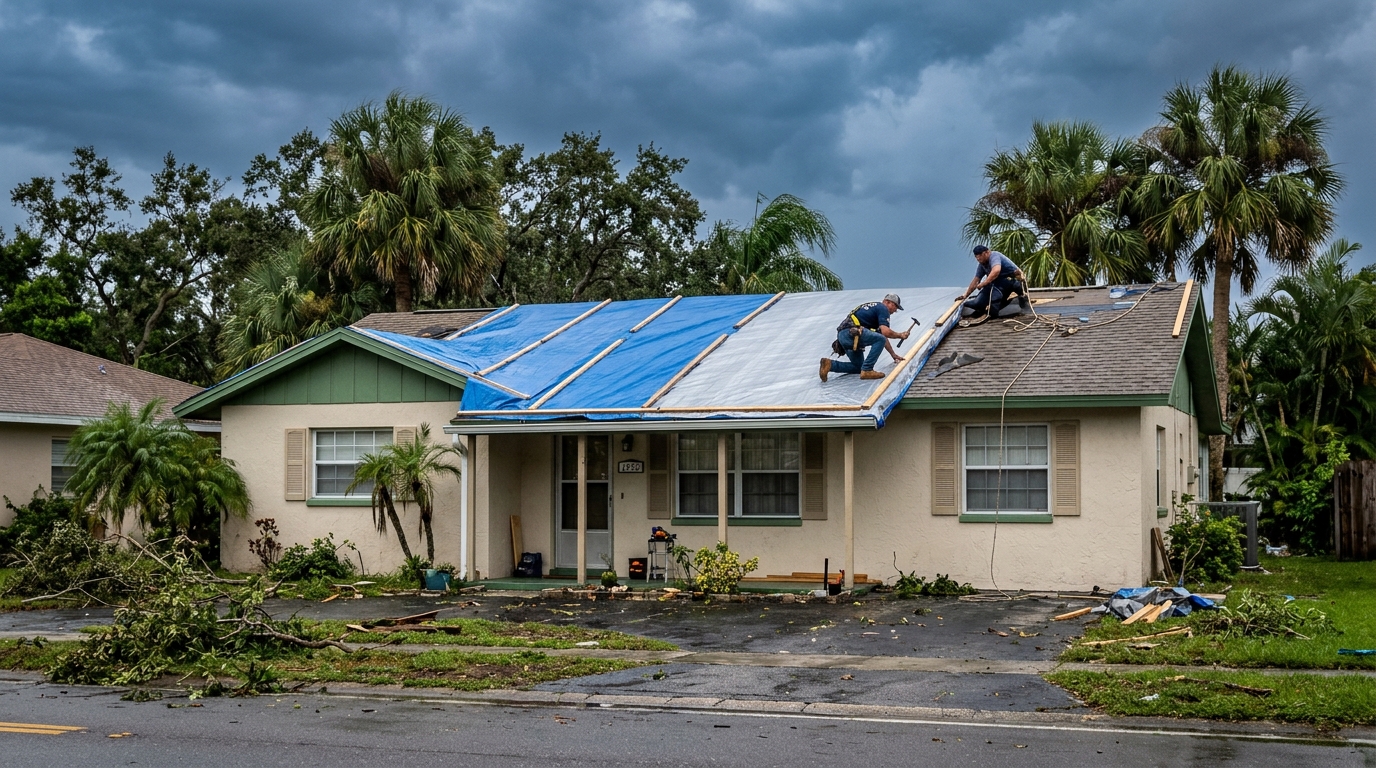
Professional emergency tarping requires specialized engineering standards that far exceed basic homeowner tarps. Crews deploy commercial-grade 12-mil woven polyethylene tarps with heavy UV stabilizers, executing the High Wind Shingle Blow-Off Tarping protocol: tarp edges and seams are wrapped completely around 2x2 southern yellow pine batten strips (sandwich wrap) before being mechanically fastened with exterior-grade screws directly into structural roof rafters. Sandbag ballasting and perimeter tensioning eliminate wind flutter, ensuring the protective barrier remains completely watertight throughout subsequent storm fronts.
Emergency intervention transitions into permanent structural stabilization once severe weather passes. Dispatched certified contractors remove saturated insulation down to the sound structural deck, install new vapor retarders, mechanically fasten high-density polyiso cover boards, and apply multi-ply SBS modified bitumen or single-ply 60-mil EPDM rubber membranes with heavy-duty termination bars.
Key Technical Engineering Protocols:
- Substrate Surface Cleansing: Clearing debris, silt, and standing water with industrial HEPA-filtered vacuum extraction and dry squeegees.
- Specialized Application: Executing the High Wind Shingle Blow-Off Tarping protocol with commercial elastomeric resins and fleece reinforcement.
- Structural Fastener Anchoring: Securing termination bars and batten strips into solid masonry or structural rafters with corrosion-resistant anchors.
4. State Energy Codes & New Jersey Uniform Construction Code (NJ UCC) Compliance
Dispatched independent contractors operate in full compliance with New Jersey State consumer protection regulations and municipal emergency make-safe provisions. Emergency temporary tarping does not require an advance building permit under the NJ UCC, allowing crews to deploy within hours of storm clearance, while permanent structural deck repairs are coordinated through standard local construction permitting channels.
When emergency repairs transition to full roof replacements, work must comply with the New Jersey Uniform Construction Code (N.J.A.C. 5:23) and the 2021 International Energy Conservation Code (IECC, NJ Edition), requiring minimum continuous insulation thermal resistance ratings (R-30 continuous insulation above deck on commercial flat roofs) and proper attic ventilation ratios on residential steep slopes.
Regulatory Compliance & Consumer Protection Standards:
- NJ UCC Chapter 15 Compliance: All assemblies meet Class A fire ratings and local wind uplift engineering standards.
- Licensed & Insured Contractors: Network contractors carry general liability, workers' compensation, and NJ DCA Home Improvement Contractor (HIC) registration.
- Emergency Make-Safe Exemption: Immediate emergency containment is authorized prior to formal permit filings under NJ UCC emergency repair provisions.
5. Preventative Property Maintenance & Storm Preparedness
Property owners must understand that emergency roof tarping is an interim protective barrier designed to safeguard the building envelope for 30 to 90 days while insurance adjusters assess losses and roofing materials are procured. Property owners should inspect tarp tie-downs following subsequent wind events and coordinate prompt permanent repairs with a licensed roofing contractor to restore full warranty protection and long-term building envelope integrity.
Proactive maintenance is the most effective safeguard against devastating water damage in Newark's dense urban and suburban landscape. Building owners who invest in routine biannual inspections and immediate drain strainer clearing protect tenant safety, preserve historic architectural assets, and avoid expensive emergency insurance claims.